
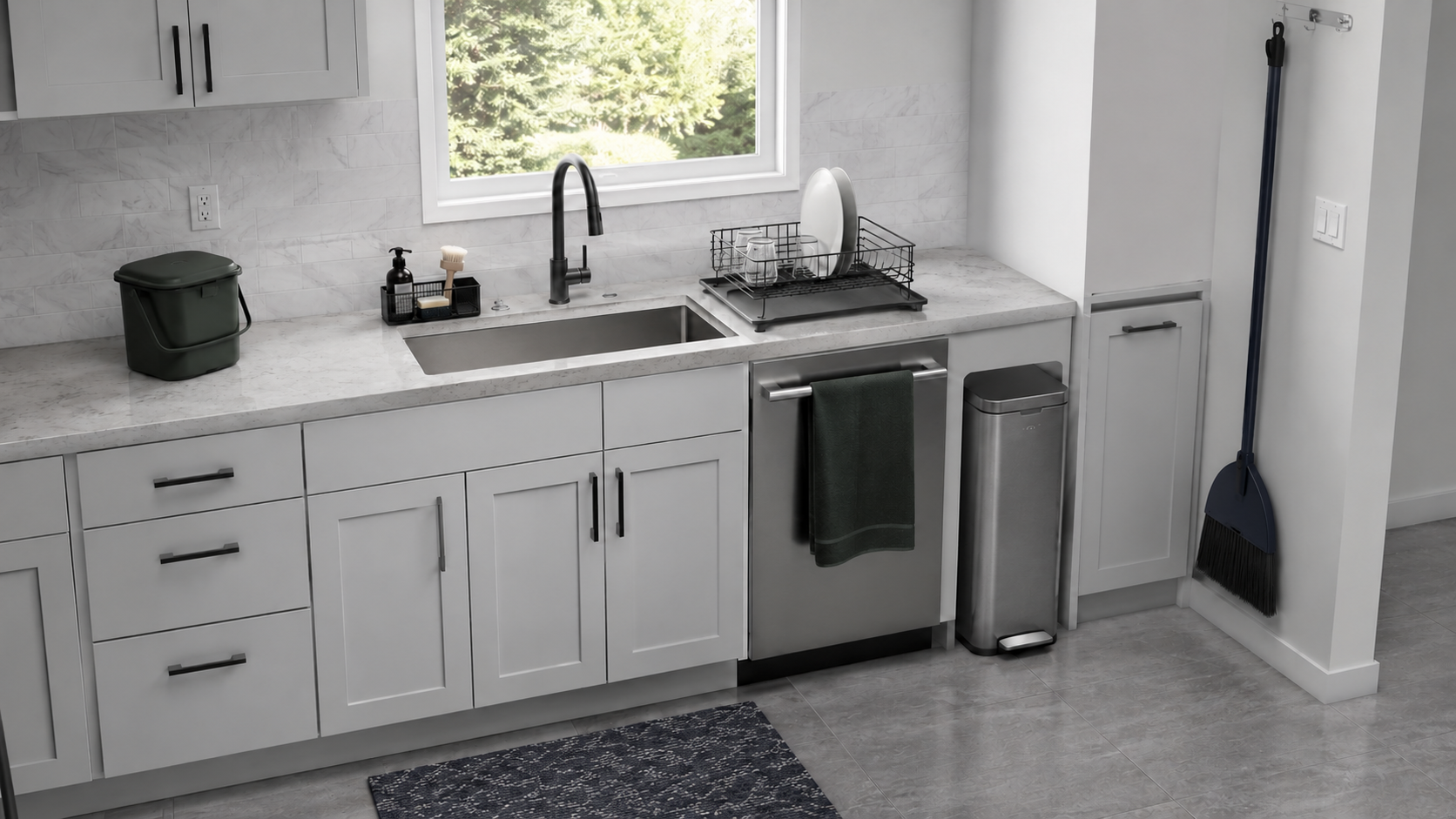
Best when cabinet storage is limited. Verify width, depth, pedal/lid clearance and the walking path around it.
Check footprint ↗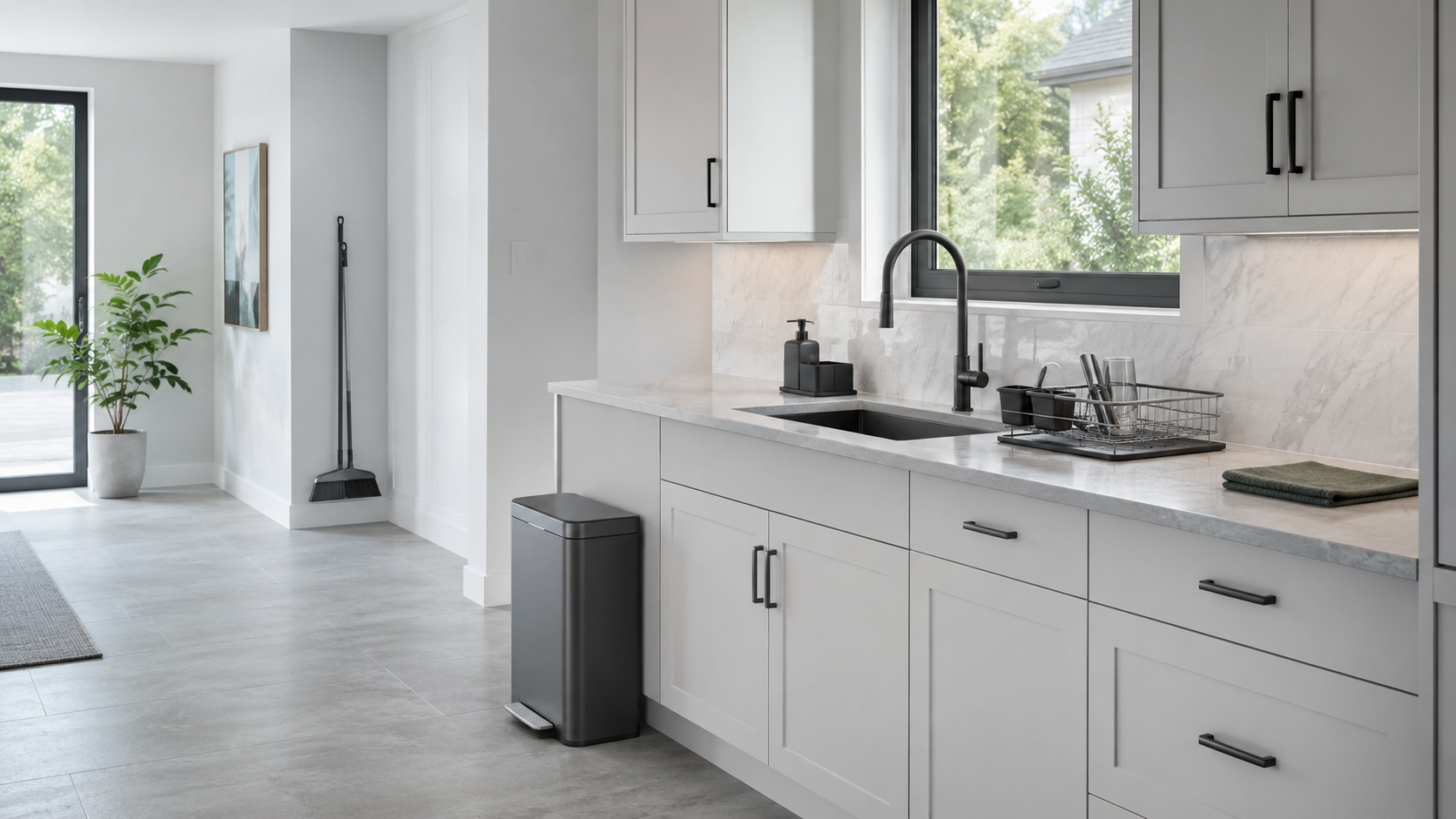
The last 10 minutes
Kitchen Cleaning & Trash Solutions for an Easier Reset
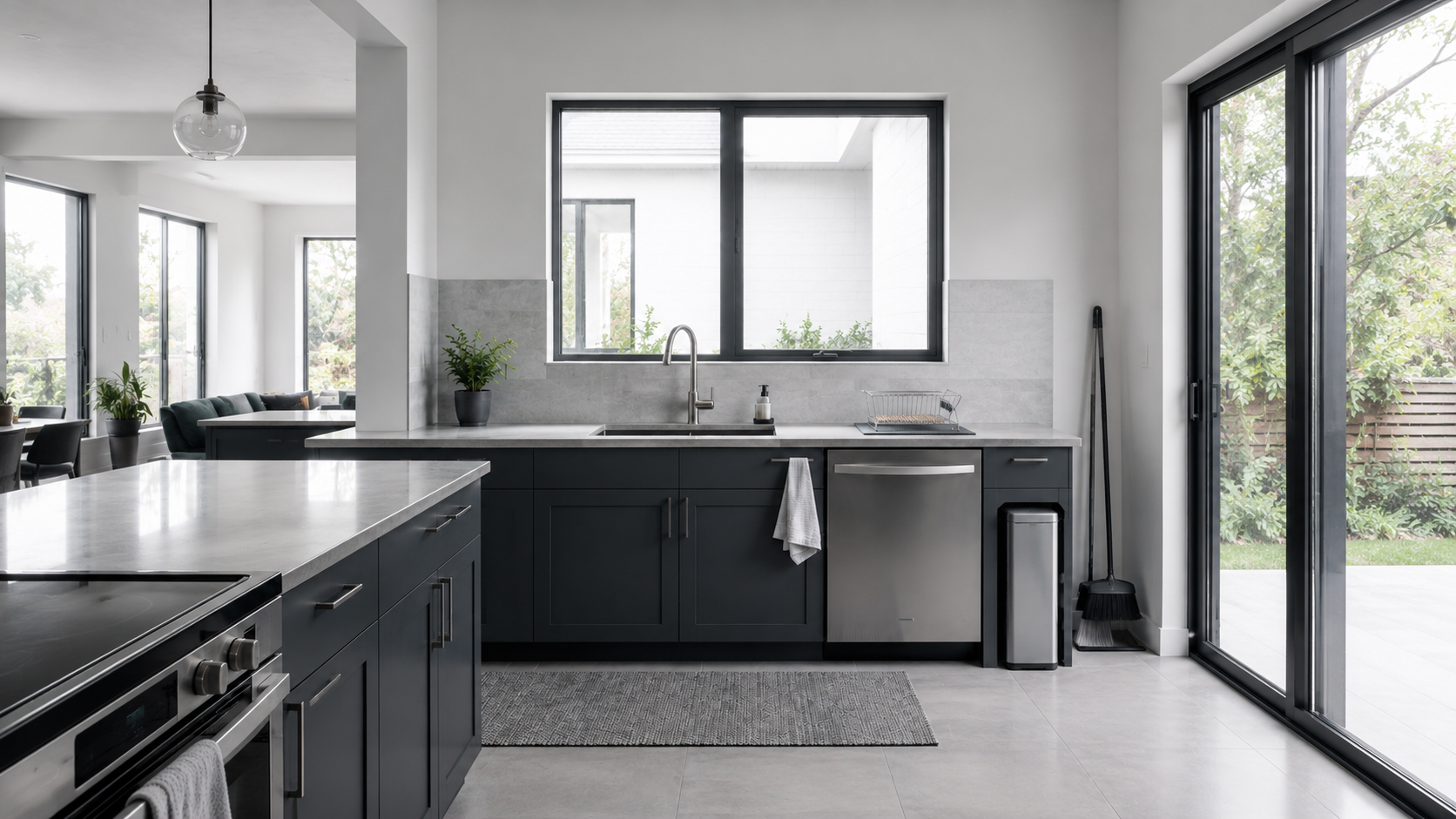
If the trash can blocks the aisle, sponges live on the counter or the dish rack never leaves, start with the route the mess takes—not another random organizer.
Map My Reset ↓
Scrape → wash → dry → sort → reset.
The reset route map
Give every mess a shorter trip home.
Choose the stage that keeps breaking down. The map highlights the physical zone, the placement rule and the products that actually belong there.
As an Amazon Associate, Ravnora Decor may earn from qualifying purchases. Product links may open on Amazon.
Stop scraps before they cross the kitchen.
Keep food-waste collection close to the prep route so scraps leave the work surface without becoming another trip across the room.
Rule: compact first. The scrap container should earn its footprint every time you prep.
Compact Food-Scrap BinCheck option ↗
Small Food-Waste CaddyExplore ↗
Mountable Food-Scrap CaddyCheck fit ↗
Keep washing tools inside one wet boundary.
Sponges, brushes and soap should support the sink without claiming the entire ledge or forcing the faucet to work around them.
Rule: protect bowl, faucet movement and hand reach before adding storage.
Bound the drying footprint before it spreads.
A rack is not compact because it looks small while empty. Judge it loaded, then protect a real stretch of counter beside it.
Rule: drying may borrow counter space; it should not permanently own the whole run.
Put waste where the route is shortest—not where a bin happens to fit.
Choose between freestanding, hidden and compact waste by the floor or cabinet footprint each one consumes while it is actually being used.
Rule: lid swing, drawer extension and walking clearance count as part of the footprint.
Dual-Compartment Step CanCompare ↗
Dual Pull-Out Waste SystemCheck cabinet ↗
Rectangular Step Trash CanCheck footprint ↗
Finish with the objects that usually never get put away.
Cleaning bottles, broom, dustpan and floor tools need a permanent return point or the kitchen never visually reaches zero.
Rule: daily tools stay one movement away; reserve products can live deeper.
Two-Tier Under-Sink Pull-OutCheck dimensions ↗
Compact Broom & Mop HolderCheck mount ↗
Broom & Dustpan SetSee option ↗
The waste footprint test
The bin is only small when its working footprint is small.
Compare where the system lives, what has to open and which kind of kitchen space it consumes.
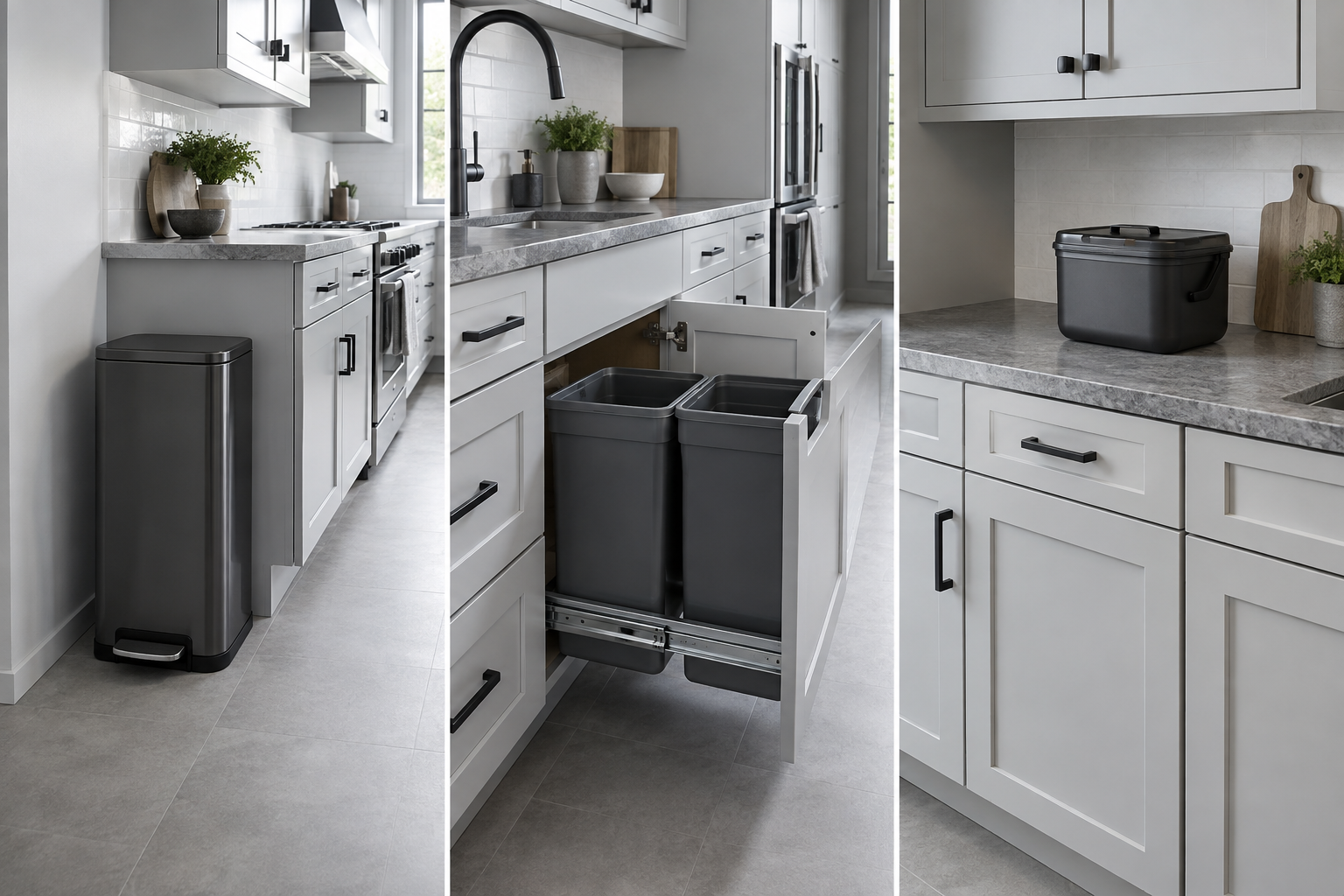
Best when a measured base cabinet can absorb waste. Verify interior opening and full pull-out clearance.
Check cabinet ↗Best when food scraps need a short trip from prep. Keep the container compact enough to preserve the work surface.
Explore option ↗Draw the wet line
Let the sink borrow one zone—not the whole counter.
The useful question is not “Do I own a dish rack?” It is “Where does the wet zone end so prep space can begin again?”
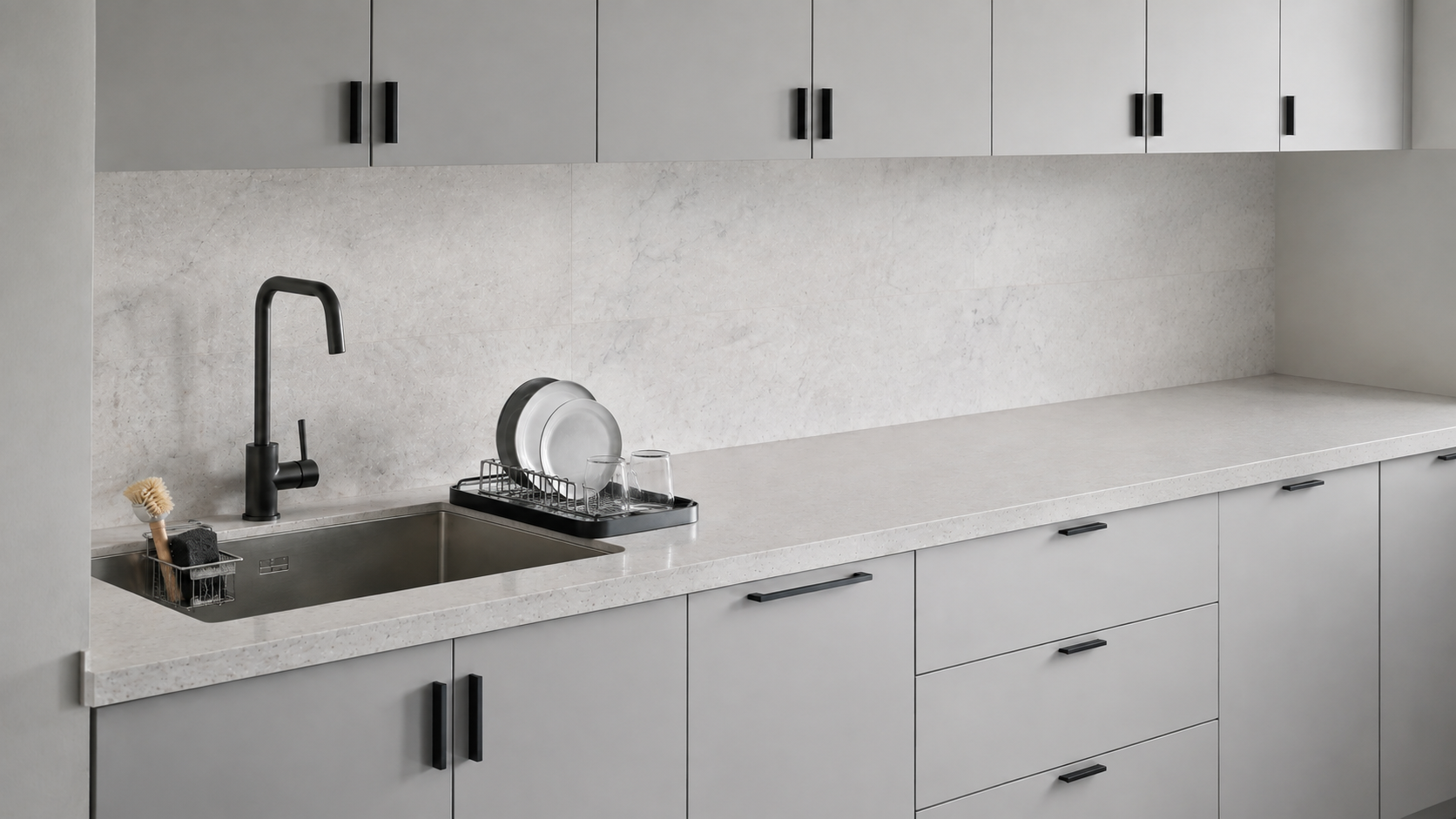 WET ZONE
PROTECT THIS SPAN
1 · Park the tools.Give sponge, brush and soap one deliberate landing point instead of several small counter positions.
2 · Load the rack mentally.Judge the rack with real plates and glasses in place—not as an empty product silhouette.
3 · Defend dry counter.Leave a visible prep span beyond the drying zone so the sink does not spread into the whole work surface.
Reach front · reserve back
The cabinet has plumbing. Plan around it.
An under-sink cabinet is not an empty rectangle. Protect pipes, shutoffs and service access first; then use the remaining front, side and rear zones intelligently.
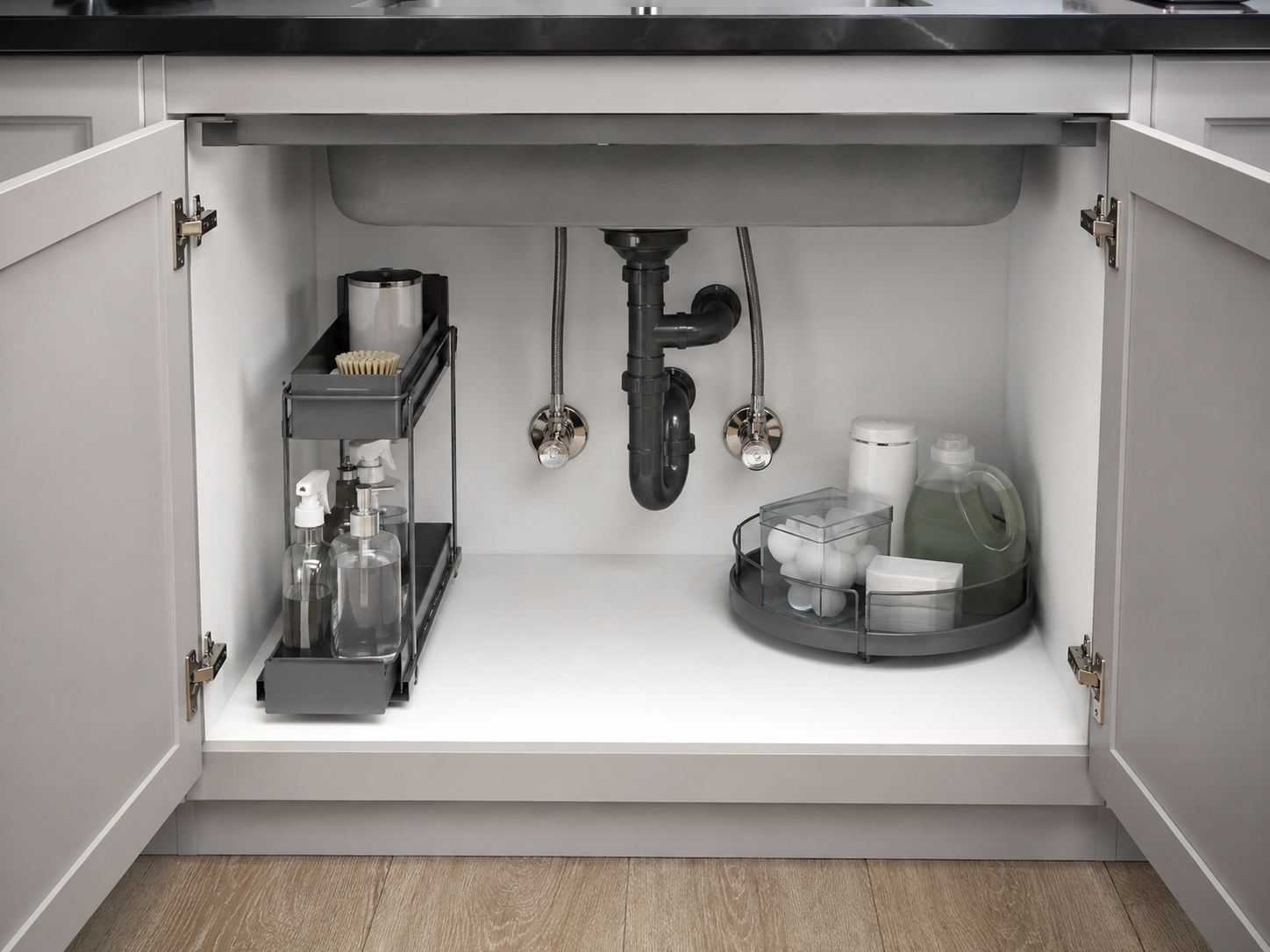
1Front = daily reachKeep frequent-use cleaners where one pull or one lift gets them.
2Back = reserveBackup products can sit deeper only when the route to plumbing remains clear.
3Center = service pathDo not force shelves, bottles or bins through the drain and shutoff zone.
Choose your reset
Start with the part of cleanup that keeps returning.
Three complete routes. Each begins with a different physical constraint rather than a different decorating style.
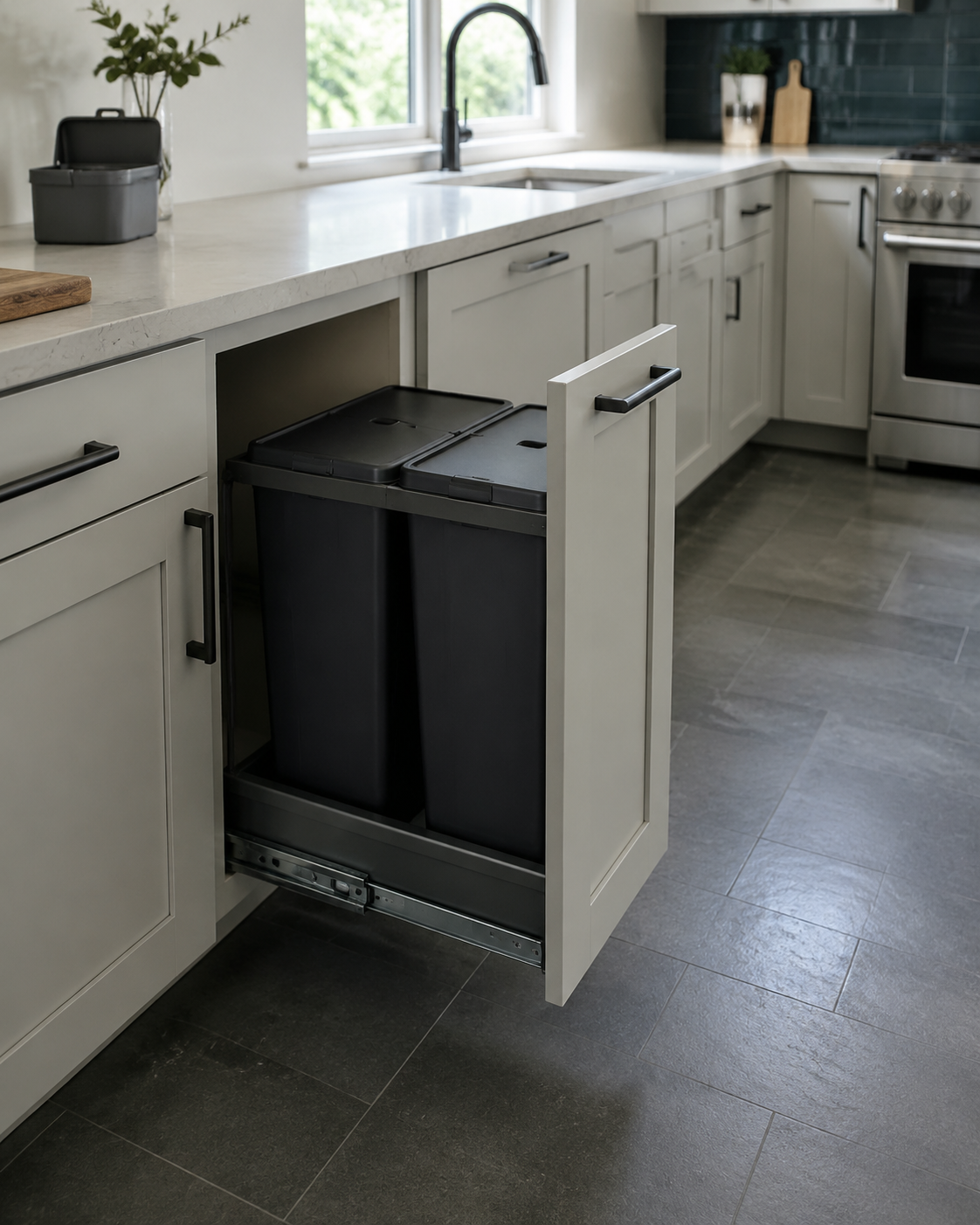
Hidden Waste Kitchen
For kitchens where the biggest interruption is the waste system itself.
Open route ↓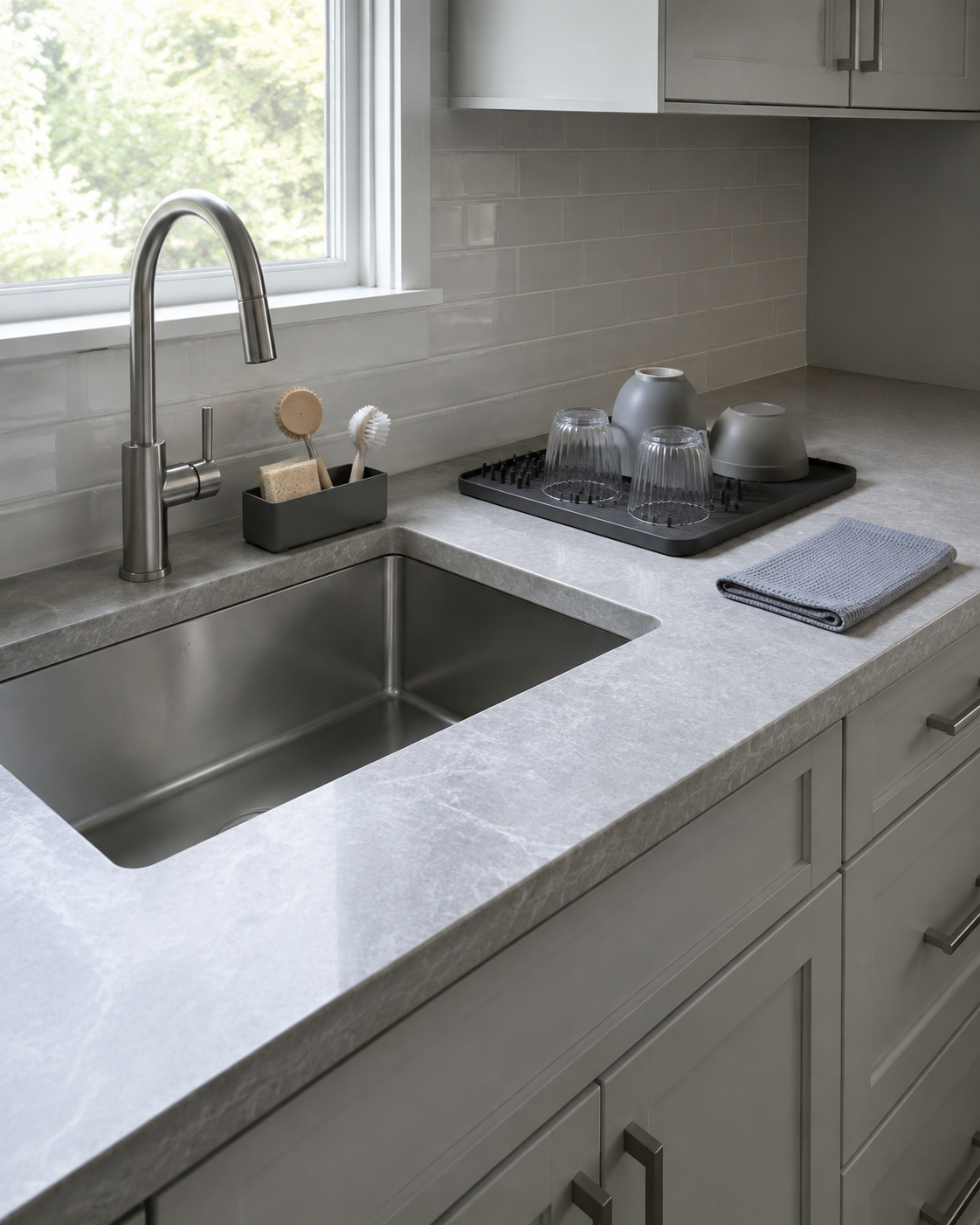
Dry Sink Reset
For counters that still look occupied after the dishes are finished.
Open route ↓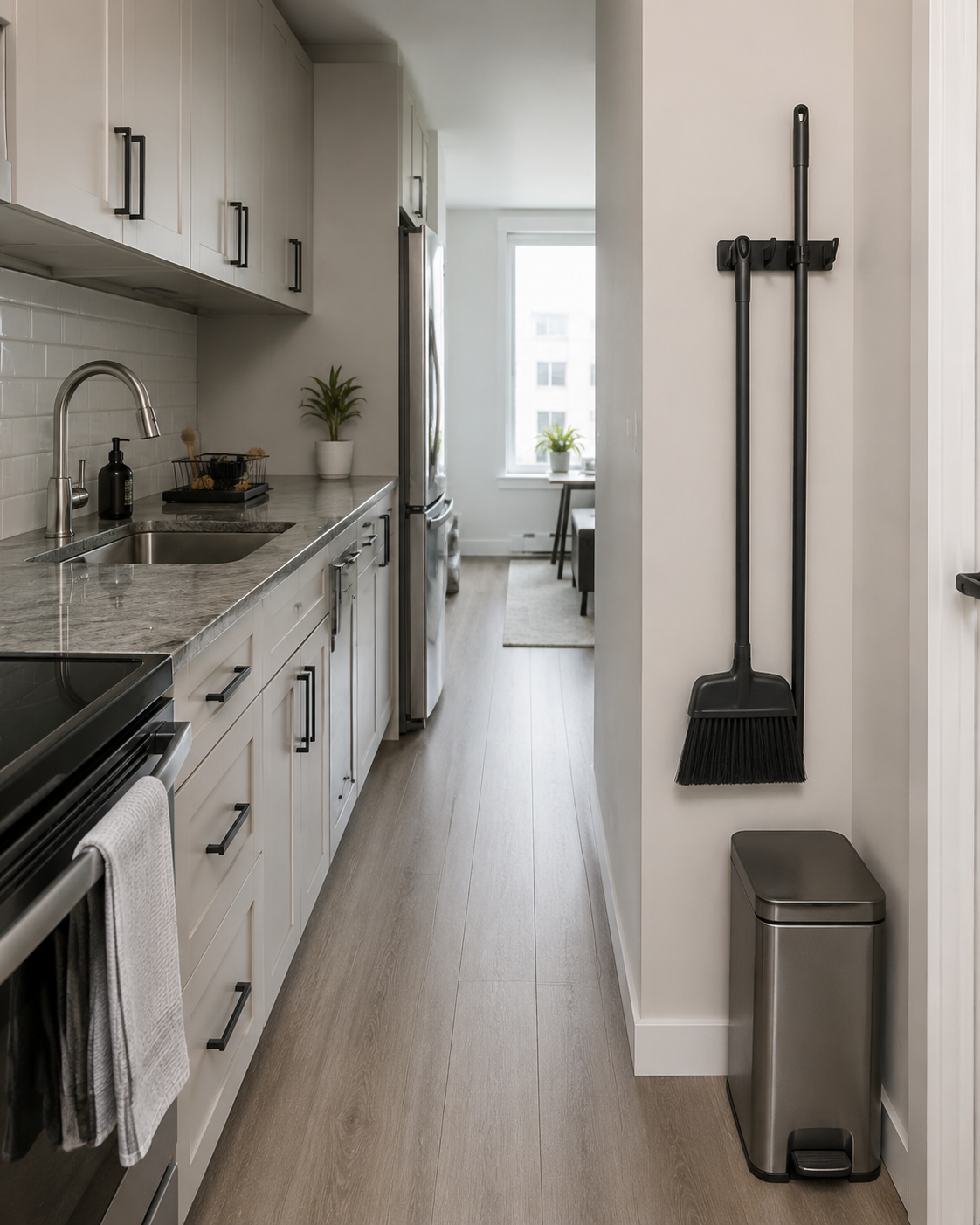
Small-Kitchen Utility Reset
For narrow kitchens where every floor inch has to keep working.
Open route ↓Route B · dry sink reset
Make the wet zone finish where the dry counter begins.
The sink feels calmer when tools have one parking point and drying has a defined boundary. The goal is not an empty sink—it is a sink that can return to a usable state.
PARK TOOLSBOUND DRYINGRETURN THE SURFACE
Route C · small kitchen
Protect the walkway before you add another cleaning object.
In a narrow kitchen, floor area is a working surface too. Keep the bin tight to the cabinet edge and move long-handled tools onto a vertical parking line.
EDGE-PARK BINGO VERTICALKEEP FLOOR CLEAR
Rectangular Step Trash CanCheck footprint ↗
Compact Broom & Mop HolderCheck mount ↗
Broom & Dustpan SetExplore ↗
The Ravnora reset edit
Eight decisions worth making first.
Not eight brands to memorize. Eight distinct jobs that can materially shorten the cleanup route.
Rectangular Step Trash Can
- Best when
- You need a visible freestanding can without adding a round footprint to the aisle.
- Check first
- External dimensions, lid movement and walking clearance.
Dual Pull-Out Waste System
- Best when
- A base cabinet can absorb waste and sorting without stealing useful floor area.
- Check first
- Cabinet opening, depth, height and full-extension clearance.
Compact Food-Scrap Bin
- Best when
- You want scraps to leave the prep surface without a trip across the kitchen.
- Check first
- Actual footprint and where the container will park between prep sessions.
Divided Sink Organizer
- Best when
- Sponges and brushes need one defined wet-zone home.
- Check first
- Sink ledge/counter footprint and faucet movement.
Extendable Dish Rack
- Best when
- Dish volume changes and the drying footprint needs some flexibility.
- Check first
- Active footprint at the size you expect to use most often.
Two-Tier Pull-Out Organizer
- Best when
- Frequently used bottles disappear at the back or behind plumbing.
- Check first
- Pipe position, door opening and usable cabinet width.
Multi-Tool Wall Rail
- Best when
- Several long-handled tools keep leaning into corners or floor space.
- Check first
- Mounting surface, rail length and the current listing's hardware.
Spin-Mop Floor System
- Best when
- Wet floor cleanup is the final step that repeatedly slows the reset.
- Check first
- Storage footprint, included pieces and current care guidance.
Complete retrieval library
Find the exact reset job you still need to solve.
Thirty unique products, collapsed into nine families. Open only the family that matches your decision.
Freestanding Waste3 options · visible floor routes
Dual-Compartment Step CanTrash + recycling in one freestanding footprint.Compare ↗
50L Stainless Step CanStraightforward single-stream kitchen waste.Explore ↗
Rectangular Step Trash CanWall-efficient premium freestanding route.Check footprint ↗
Hidden Waste5 options · cabinet routes
Dual Pull-Out Waste SystemTwo-bin cabinet route for measured openings.Check cabinet ↗
Compact In-Cabinet CanSmall hidden waste route when full pull-outs are unnecessary.Explore ↗
Double 35-Qt Pull-Out WasteDual-bin hidden capacity for a suitable base cabinet.Check dimensions ↗
Single 35-Qt Pull-Out WasteSingle-bin hidden route with simpler sorting needs.Explore ↗
Soft-Close Double Pull-OutPremium dual hidden-waste route.Check cabinet ↗
Food-Scrap Bins3 options · prep-to-waste handoff
Compact Food-Scrap BinSmall collection point near food prep.Explore ↗
Small Food-Waste CaddyCompact countertop route for everyday scraps.See option ↗
Mountable Food-Scrap CaddyAlternative route when surface footprint is limited.Check fit ↗
Sink Control4 options · sponge, brush and soap parking
Divided Sink OrganizerOne structured home for several washing tools.Explore ↗
Stainless Sinkware CaddyCompact counter-side wet-tool station.See option ↗
Minimal Sponge HolderSmallest footprint when only a sponge needs parking.Check fit ↗
Suction Sink OrganizerMoves wet-tool storage off the counter edge.Check surface ↗
Dish Drying4 options · control the active footprint
Compact Counter Dish RackEveryday drying with a restrained counter footprint.Explore ↗
Extendable Dish RackAdjustable footprint as dish volume changes.Check span ↗
In-Sink / Counter RackFlexible placement between basin and counter.Compare ↗
Compact Stainless Dish RackStructured drying for a measured surface zone.Explore ↗
Under-Sink Access3 options · front reach and deep retrieval
Two-Tier Pull-Out OrganizerFront-reach access for bottles around a measured pipe layout.Check dimensions ↗
Rotating Cabinet TrayReach deep corner items without a full pull-out structure.Explore ↗
Slide-Out Cabinet OrganizerRetrieval from deeper cabinet space.Check cabinet ↗
Tool Parking2 options · vertical return points
Compact Broom & Mop HolderSmall vertical parking line for long-handled tools.Check mount ↗
Multi-Tool Wall RailLonger wall route when several cleaning tools need one home.Check wall ↗
Floor Reset2 options · wet and dry finish
Spin-Mop Floor SystemWet floor-reset route for the final cleanup stage.Explore ↗
Broom & Dustpan SetDry floor-reset route with one coordinated tool pair.See option ↗
Detail Cleaning4 options · surfaces, cookware and hands
Microfiber Cleaning ClothsGeneral daily wipe-down tools.Explore ↗
Fine Glass Microfiber ClothsFiner cloth route for glass and polished surfaces.See option ↗
Dish & Cookware Scrub BrushCompact hand tool for cookware and dish cleanup.Explore ↗
Reusable Cleaning GlovesHand protection for wet household cleanup.Check option ↗
Before the kitchen earns “reset”
Verify the room—not just the product photo.
Dimensions, configuration, materials and included pieces can vary by current listing or option. Match the product to the exact route your kitchen has to support.
FitConfirm the complete external dimensions for the exact option you plan to buy.
SwingAllow for lid movement, cabinet doors, drawers and full pull-out extension.
PlumbingKeep pipes, disposal components, shutoffs and service access reachable.
Wet zoneCompare caddy or rack dimensions with the sink ledge and actual counter span.
MountConfirm the mounting surface and the installation method shown in the current listing.
CompatibilityCheck included pieces, configuration, liner fit, care guidance and current variant details.